Our ecosystem
Many parts, one system.
One health cannot be lived in one place or by one discipline. It needs knowledge holders and their Traditional Councils, seeds and land, research and learning, and the tools that hold them together. Green Health connects these parts so that each makes the others stronger.
Digital tools keep track of plants, places and permissions, and let a growing network of places share what it learns, while the knowledge stays with the people it belongs to.
The ecosystem that lets the Maya One Health approach work
A world-knowledge healing system needs the whole ecosystem.
It depends on forest and seed, on Healers who find apprentices, on modern science as an equal partner, on places to learn and on fair pay.
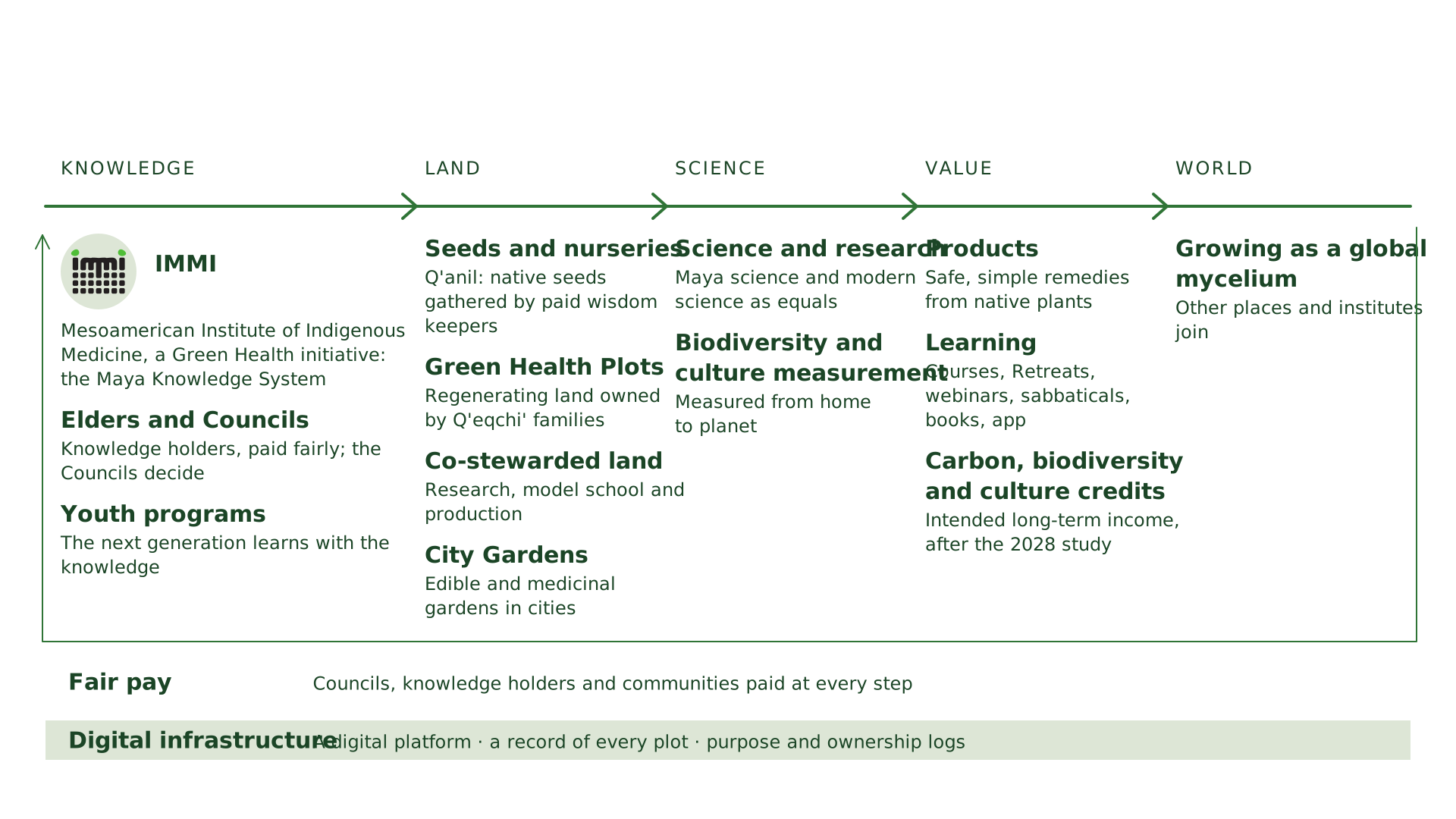
Each part is there because the others need it. The medicine depends on forest and seed, so there are nurseries and plots. Healers need apprentices to pass their knowledge on, science works with them on the evidence, and places to learn bring people to the knowledge. Knowledge flows into the land, the land into science, science into value, and value out into the world; what the world gives back returns to the communities. IMMI, the Maya Knowledge System, sits inside it, at IMMI Muxux in Guatemala City and IMMI Petén. Beneath everything run fair pay, with Traditional Councils, knowledge holders and communities paid at every step, and the digital infrastructure that carries it all. So a partner who funds one part strengthens the whole.
Knowledge
Knowledge shared, in a respectful relationship.
The relationship with modern research is one of equals. Traditional Councils and knowledge holders co-lead the research with scientists, and each side learns from the other.
The Maya Knowledge System
IMMI
- The Mesoamerican Institute of Indigenous Medicine, a Green Health initiative
- A place that holds the knowledge to share it respectfully, with its Traditional Councils and knowledge holders
- Its first places: IMMI Muxux and IMMI Petén
The authority comes from the culture itself
Elders and Traditional Councils
- Traditional Councils and knowledge holders decide what is shared, how and with whom
- Wisdom keepers are paid for the seeds they gather, and knowledge holders are to be paid as researchers and teachers
- How we act together is set down in the Codex
The next generation
Youth programs
- Young people learn with the knowledge, from the Elders who hold it
- Learning materials for schools and communities, in several languages
- The Ajilonel School in IMMI Petén is planned to train new Healers
Land
Living landscapes, from a family plot to a city park.
Q'anil, the seed
Seeds and nurseries
- Maya wisdom keepers gather the seeds of native species that no one else collects, and are paid for it
- Community nurseries grow them into medicinal and forest plants
- Q'anil means seed: the living beginning from which knowledge, plants and relationships can grow
Families and landowners
Green Health Plots
- Q'eqchi' families in Petén regenerate their own land with plants from the community nursery, on long-term plans
- Landowners can join the same way: they keep their land and share the plants, stewardship and infrastructure
- More places for the network, and a way for small landowners to be part of something bigger
In planning
City Gardens
- With a municipality, a city park becomes a garden of native food and medicinal plants
- Each plant carries its story, for anyone who walks by
- A way for cities to take part in one health, close to home
Science and learning
Evidence that can be checked, and learning that is shared.
Maya science and modern science as equals
Science and research
- Indigenous researchers lead on the questions that matter most in their own knowledge
- They work in teams with national and international researchers: botany, pharmacology, medicine, epidemiology, ecology
- Peer-reviewed work already exists, and an evidence base for local medicines is being built together
Kawilal measurement
Biodiversity and culture, measured together
- Kawilal is a Q'eqchi' word for interconnected health
- The Kawilal community guide measures the health of people, animals and land with indicators that make sense to science and to the Traditional Councils
- Communities in Petén already use it to assess their own health risks
Learning
Knowledge to share
- Raxnaq'il Nuk'aslemal (2016), the Traditional Councils' book: knowledge passed on orally, set down on paper for the first time, with 67 knowledge holders as its authors
- Talks on Maya medicine
- At ETH Zurich, the design studio "Curative Gardens" worked on a medicinal garden for IMMI in Guatemala City (2025)
The world
Infrastructure that travels. Knowledge that stays.
Shared by every place
The digital infrastructure
- A Knowledge System in which every item carries its own permission, so that knowledge holders can limit or withdraw consent
- Digital records of the plots and a field app for farmers, Healers and community monitors, being built
- Credits for carbon, biodiversity and culture are intended, subject to legal and regulatory review
Like the underground network of a forest
Growing as a network
- Other places and institutes join on shared standards and keep their own governance and authority
- The infrastructure travels; the knowledge, the culture and the authority stay with their places
- Translate the health principle, not necessarily the plant