
Our story
Proving that a medical tradition is alive.
Maya medicine is a knowledge system with its own principles, specialties and methods, and it is practiced today. This is the story of how Green Health came to work with it, and why health care in Guatemala needs what it knows.
Why Green Health
Universal health coverage is still a dream in Central America.
Copying foreign models will not get us there.
about 40%
Care that people pay for themselves
Public investment covers only about 40% of the costs of accessing care in Guatemala; only about 30% of the poorest, most of them Maya, use formal health services.
up to two thirds
Care from traditional Healers
In the Petén lowlands, traditional Healers provide up to two thirds of the care Indigenous people seek: a system built on 2,000 years of empirical knowledge.
a third of the forest
A medicine under stress
The ecosystems this medicine depends on are under severe stress: Petén has lost a third of its forest since 2001. The Healers and wisdom keepers, Ajq'omanel and Ajilonel, are marginalized and often unable to teach new generations.
Green Health brings more than 15 years of intercultural health research, with evidence for scaling up the holistic Kajtzuk model. Kajtzuk sees the human being in four parts, body, spirit, mind and emotions, which stay in balance for holistic wellbeing.
Sources: Geck et al. 2020 (public investment) · Berger-González et al. 2016 (formal services; the research) · Kawilal project report, Universidad del Valle de Guatemala, Swiss TPH and GIZ, 2023 (care in Petén) · NASA Earth Observatory, 2024 (forest, 2001 to 2023)
History
More than two thousand years of practice
Maya medicine has been practiced for more than two thousand years. It holds knowledge of plants and food, of the body and its balance, of territory and of time. The Green Health Codex calls it No'j: wise knowledge, knowledge applied with love.
For centuries this knowledge was kept outside formal academia. Across Mesoamerica, Ajq'omanel (traditional Healers), midwives, spiritual guides, farmers and plant specialists still practice it, teach it and carry it forward.
Where it began
It began with plants, people and a place.
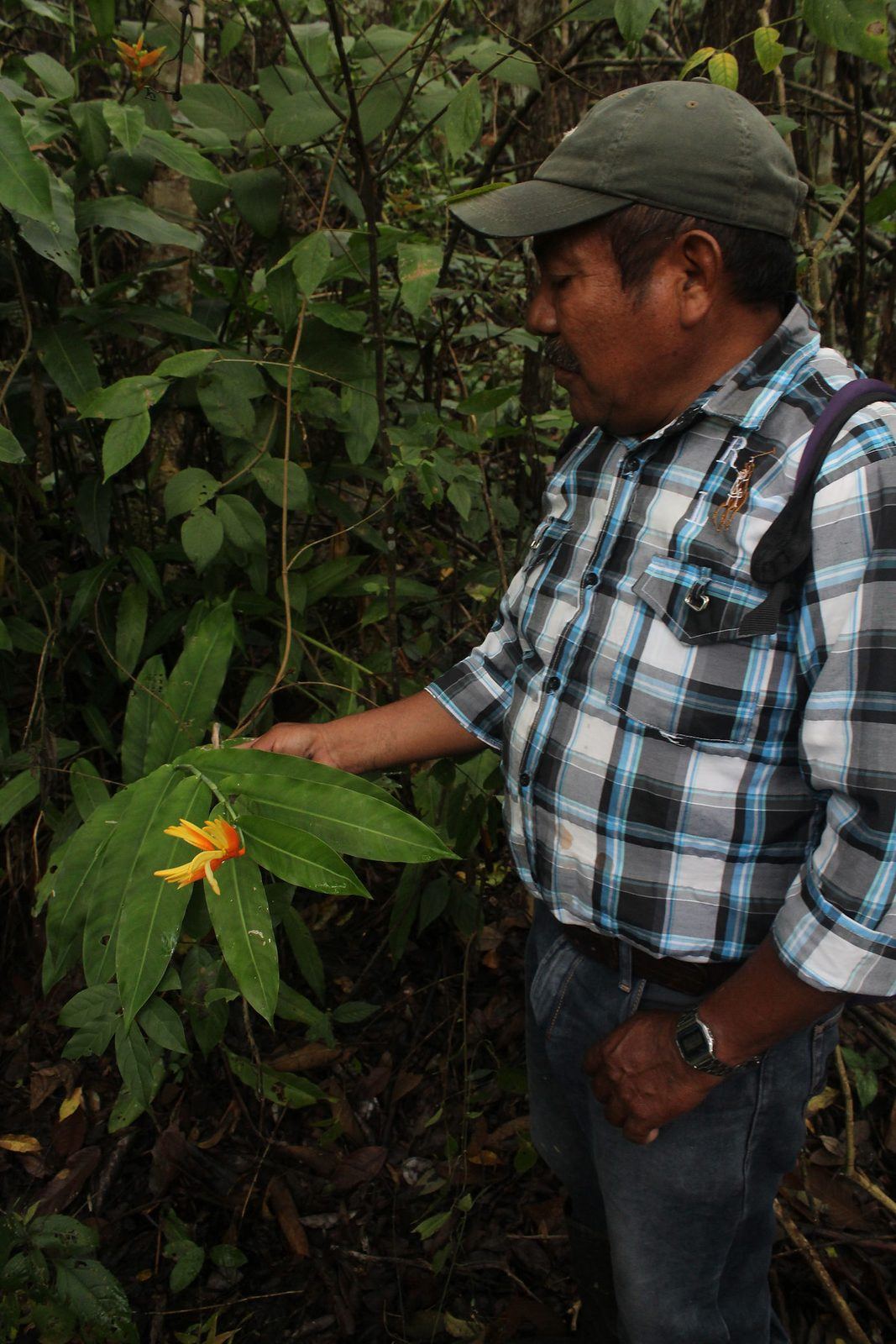
Green Health grew out of fieldwork in the Petén lowlands of Guatemala: a medical anthropologist working with Indigenous women and men, documenting the medicinal plants they use and the place those plants have in daily life, in an area with few public health services.
What she found was a whole cycle of healing. It needs the places where the plants grow, the plants themselves, the wisdom keepers who know them, and an ecosystem that sustains all of them. In Maya understanding, the medicine works where one health is alive: people, plants, animals and land, cared for together. So it is more than a way of treating illness. It is a way for a whole society to look at healing, as something a community does with its land.
The door opened through people. Elders, Ajq'omanel, midwives and herbalists chose to share their world, and through them a first bridge between their knowledge and modern science became possible.
01
The Traditional Councils decide
Five Traditional Councils of Elders held their own consultations before any interview, and gave their consent in a ceremony at Tikal, in Petén, in January 2011.
02
Elders interview Elders
The research was led jointly by a Maya Elder and a scientist, in the Elders' own languages, and every synthesis went back to the Traditional Councils.
03
The knowledge holders become authors
In 2016 the Traditional Councils published what they chose to share as a book, with 67 knowledge holders named as its authors.
The research lineage
From fieldwork to an institution
-
2011 to 2014
Research with five Traditional Councils and ETH Zurich
Maya medical specialists of five Traditional Councils and scientists of ETH Zurich studied cancer-healing systems together, under a cooperation agreement.
-
2016
A book with the Traditional Councils
Raxnaq'il Nuk'aslemal. Medicina Maya' en Guatemala, written with the Traditional Councils of Elders, with the support of ETH Zurich and the Swiss Embassy in Guatemala.
-
2019 to 2022
The Green Health Project
UCL School of Pharmacy, Universidad del Valle de Guatemala and the Releb'aal Saq'e' Council (ACGERS) studied Indigenous participation in research and benefit sharing, with the UK Darwin Initiative.
-
2026
A Codex and an institute in the making
Several Maya Traditional Councils and Ajq'ijab' approved the Green Health Codex of Principles and Conduct, and the Mesoamerican Institute of Indigenous Medicine (IMMI) is being built.
Our role as scientists is to keep building respectful bridges for mutual learning.